Types of dental crowns, compared honestly
There is no single best crown. There is a best crown for a particular tooth, bite and budget. Here is how the main materials compare, and how a dentist decides.
 Medically reviewed by Dt. Hüseyin Yavuz Özbek, implant surgeon · Updated October 2026
The three main crown types are zirconia (very strong, metal-free, good for back teeth, bridges and grinders), E-max lithium disilicate (glass-ceramic with the most natural translucency, often used on front teeth) and porcelain-fused-to-metal (a metal core under porcelain, long track record, but a grey edge can show at the gum). A 2026 systematic review found five-year survival above 96% for solid zirconia, solid lithium disilicate and metal-ceramic single crowns alike, so the choice is mostly about position, looks and bite.
- Zirconia
- £150 / tooth
- E-max
- £225 / tooth
- Metal-ceramic
- in your plan
- Guarantee
- 5 years
A crown is a hollow cap made to fit over a tooth that has been shaped to receive it. It restores the tooth's shape and protects what is left of it. The cap can be made from several materials, and the material changes how it looks, how strong it is, how much tooth has to be removed and what can go wrong later.
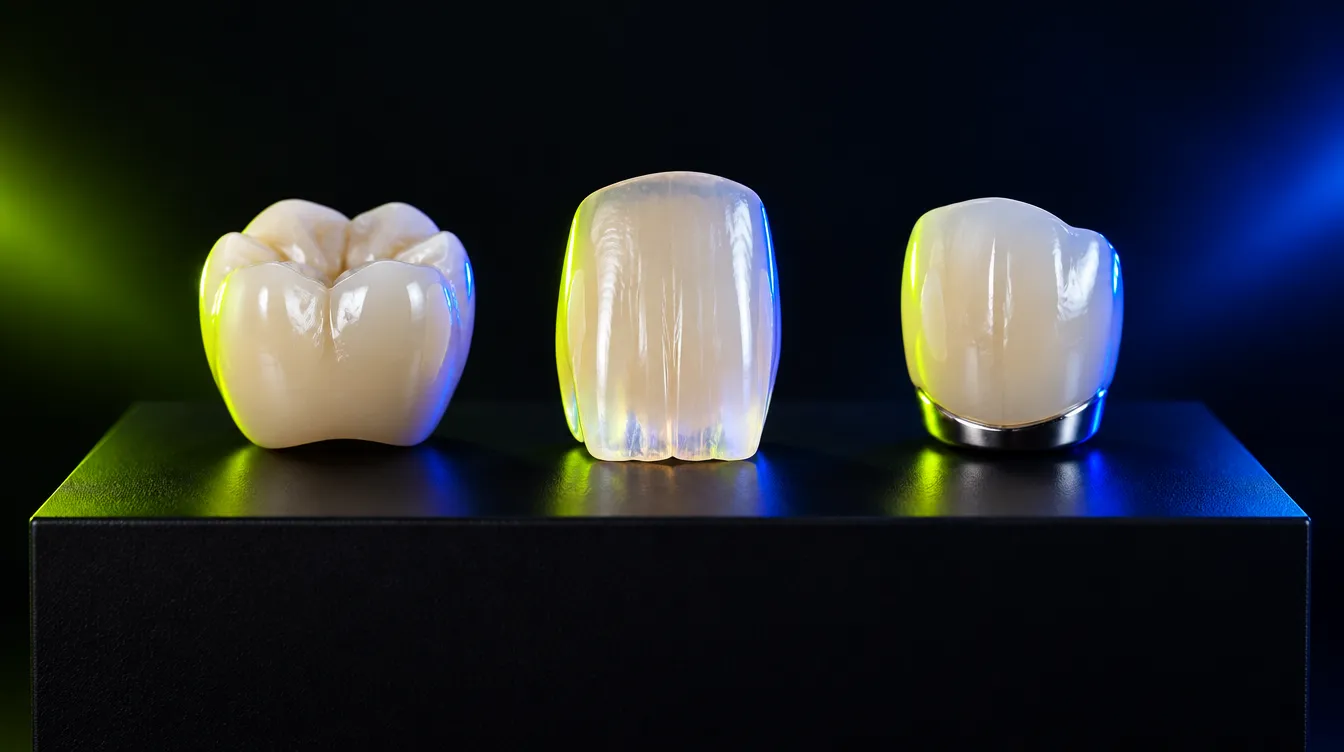
The three materials at a glance
| Material | Best at | Watch out for | Our price |
|---|---|---|---|
| Zirconia | Strength. Back teeth, bridges, people who grind, full sets. | The most opaque option; very bright shades can look flat on front teeth. | £150 per tooth |
| E-max (lithium disilicate) | Looks. Front teeth, single crowns, matching natural teeth. | Less suited to long bridges and heavy grinding. | £225 per tooth |
| Porcelain-fused-to-metal | Long track record; strong metal core. | A grey line can show at the gum; porcelain can chip; needs the most tooth removed. | In your written plan |
What the research says about survival
The best evidence for crowns comes from systematic reviews that pool many clinical studies. In 2015, a large review in Dental Materials compared more than 14,000 single crowns. It found five-year survival of about 95% for metal-ceramic crowns and about 97% for lithium disilicate glass-ceramic crowns. The zirconia crowns of that era, which were mostly a zirconia core covered with hand-layered porcelain, did less well and had more porcelain chipping.
That is why the materials have moved on. A 2026 update by largely the same research group separated solid ("monolithic") crowns from layered ones. Five-year survival was 98.5% for monolithic lithium disilicate, 97.1% for metal-ceramic and 96.8% for monolithic zirconia, and the monolithic designs chipped far less often than layered ones. In plain terms: modern solid zirconia and solid E-max crowns both perform well, and the old reputation of zirconia for chipping mostly belongs to the layered kind. Our blog post on monolithic and layered zirconia goes into this.
How much tooth each one needs
All full crowns need the tooth reduced on every side, so the crown is not bulky. In a well-known lab study, preparing front teeth for full crowns removed about 63% to 72% of the visible tooth by weight, with metal-ceramic preparations at the top end. Veneer preparations removed roughly 3% to 30%. The exact figure in a real mouth depends on the tooth, its position and the material, but the order of magnitude is the thing to remember.
Solid zirconia can be made thinner than layered crowns because it does not need room for a porcelain layer. E-max needs a bit more thickness to be strong. Metal-ceramic needs room for both metal and porcelain. If you are comparing plans, ask how much each tooth will be reduced and why that material was chosen. Our page on what crown preparation does to your teeth explains the risks of over-preparation.
A quick chooser
This is how dentists usually think about it. It is a starting point for a conversation, not a diagnosis.
| Your situation | Usually suggested | Why |
|---|---|---|
| One broken or root-filled back tooth | Zirconia | Takes chewing forces well; looks fine at the back. |
| One front tooth that must match its neighbours | E-max | Translucency closest to enamel; easiest to blend. |
| You grind or clench at night | Zirconia, plus a night guard | Most resistant to fracture under heavy load. |
| A bridge to fill a gap | Zirconia | Strength across several units. |
| A full smile makeover | Often E-max at the front, zirconia behind | Looks where they show, strength where you chew. |
| Healthy teeth, you just want them whiter or straighter | Probably not crowns | Whitening, bonding, aligners or veneers keep far more tooth. See crowns vs veneers. |
Full-mouth crowns are a plan, not a material
"Full mouth crowns" means crowning most or all of the teeth that show when you smile, often 16 to 28 teeth. It is sometimes the right answer for teeth that are badly worn, broken or covered in old failing dental work. It is the wrong answer for healthy teeth. See full mouth crowns for when it is justified and how it is planned.
Where Precious Dental stands
Our usual materials are zirconia and E-max. We rarely use porcelain-fused-to-metal now, though we will discuss it if you have a reason to want it. Every crown we fit is designed from a digital scan and tried in before it is fixed, so you see the shape, shade and bite first. Crowns carry a 5-year written guarantee with conditions, which are on the guarantee page. Prices are on crown prices.
Common questions
What is the strongest type of crown?
Among tooth-coloured materials, zirconia is the strongest. Metal-ceramic crowns are also strong because of the metal core. Strength is not everything, though: on a front tooth, E-max is usually strong enough and looks more natural.
Which crown looks most natural?
E-max lithium disilicate lets light pass through it in a way that is close to enamel, so it is often the most lifelike on front teeth. Newer, more translucent zirconias have narrowed the gap, at some cost to strength.
Can I mix materials in one smile?
Yes, and it is common: E-max on the front teeth that show most, zirconia behind where the bite is heaviest. The shades are matched so the change is not visible.
Do different crowns need different amounts of drilling?
A little. Every full crown needs the tooth shaped down on all sides. Metal-ceramic crowns typically need the most room, solid zirconia can be made thinner, and E-max sits in between. Your plan should say which teeth are prepared and why.
Does Precious Dental use porcelain-fused-to-metal crowns?
Rarely. Zirconia and E-max are our usual choices. If you have a reason to want metal-ceramic, ask; the price comes in your written plan.
Sources
- Pjetursson BE et al. (2026). A systematic review and meta-analysis evaluating the survival, failure, and complication rates of metal-ceramic, veneered, and monolithic all-ceramic tooth-supported single crowns, Part 1. Int J Prosthodont
- Sailer I et al. (2015). All-ceramic or metal-ceramic tooth-supported fixed dental prostheses (FDPs)? Part I: Single crowns. Dent Mater
- Zhang Y, Lawn BR (2018). Novel zirconia materials in dentistry. J Dent Res
- Ivoclar. IPS e.max CAD (manufacturer information, flexural strength)
- Edelhoff D, Sorensen JA (2002). Tooth structure removal associated with various preparation designs for anterior teeth. J Prosthet Dent
- Oral Health Foundation. Crowns
Checked October 2026. Where we give our own view as a clinic, we say so.
Send a selfie smile. Get a written crown plan.
A few photos of your teeth or a recent X-ray is enough to start. A dentist looks at them and you get a written plan: which teeth, which material, why, and the price in pounds. If you don't need crowns, we'll tell you.