Porcelain-fused-to-metal crowns: the old reliable
Porcelain-fused-to-metal crowns, also called metal-ceramic or PFM, were the standard crown for decades. Plenty of people still have them. Here's what they are good at, why they have fallen out of favour, and when they still make sense.
 Medically reviewed by Dt. Hüseyin Yavuz Özbek, implant surgeon · Updated October 2026
A porcelain-fused-to-metal (PFM) crown has a thin metal shell covered with tooth-coloured porcelain. It has a long clinical record, with about 95% to 97% survival at five years in systematic reviews, similar to modern all-ceramic crowns. Its drawbacks are cosmetic and practical: the metal can show as a grey line at the gum, the porcelain can chip, and it usually needs the most tooth removed. Most clinics, including Precious Dental, now use zirconia or E-max instead; a PFM price, if you want one, comes in your written plan.
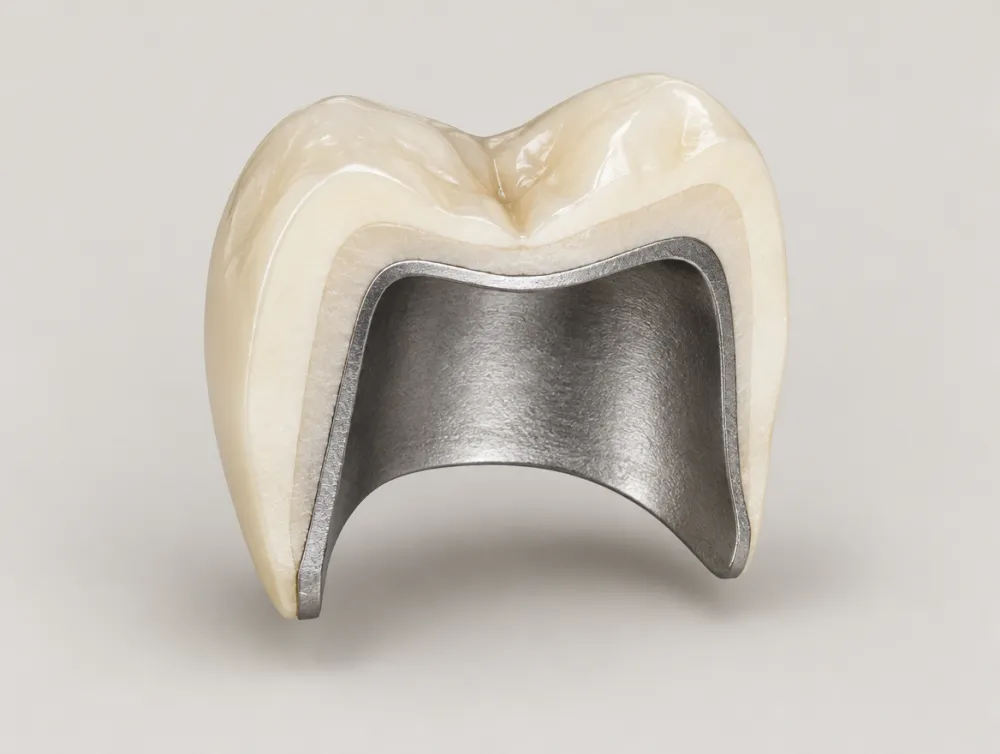
How a PFM crown is built
A technician first makes a thin metal shell, called a coping, that fits over the prepared tooth. The alloy may be based on precious metals such as gold and palladium, or on non-precious metals such as nickel-chromium or cobalt-chromium. An opaque layer hides the metal, then tooth-coloured porcelain is built up and fired onto it in layers. The metal gives strength; the porcelain gives the colour.
Because the crown has to fit both metal and porcelain into the space around the tooth, a metal-ceramic preparation is usually the deepest of the common crown types. In a widely cited lab study of front teeth, the metal-ceramic preparation removed about 4.3 times as much tooth as a standard veneer preparation.
The track record
This is where PFM crowns shine. They have been used for more than half a century and are the benchmark other crowns are compared against. The 2015 Dental Materials review estimated 94.7% five-year survival for metal-ceramic single crowns; the 2026 update put it at 97.1%. Those figures are in the same range as modern zirconia and lithium disilicate.
A long-term study from Hong Kong followed teeth that were alive when they were crowned with metal-ceramic crowns for an average of about 14 years. Around 16% lost their nerve over that time, a reminder that the preparation itself, not just the material, carries a risk.
Why most clinics have moved on
- The grey line. If the gum recedes, the metal edge can show. Even when it does not, thin gum can look greyish over the metal.
- Opacity. The opaque layer that hides the metal also stops light passing through, so PFM front teeth can look flatter than E-max.
- Chipping. The porcelain layer can chip off the metal, especially on back teeth or in people who grind.
- More tooth removed. Room is needed for metal and porcelain together.
- Metal sensitivity. Rarely, people react to nickel-containing alloys.
When PFM still makes sense
Some dentists still choose metal-ceramic for long bridges or particular bite problems, or simply because they have decades of experience with it. If you already have a sound PFM crown you are happy with, there is usually no need to replace it. Replacing a crown means cutting it off and preparing the tooth again. Read crown margins explained to understand what happens at the edge where problems usually start.
Where Precious Dental stands
We rarely use porcelain-fused-to-metal crowns now. Our usual choices are zirconia and E-max, which avoid the grey margin and, in the case of solid zirconia, the chipping risk. If you would prefer metal-ceramic, ask us; if the dentist agrees it suits you, the price comes in your written plan. Compare all three on crown types.
Common questions
Are PFM crowns bad?
No. They have decades of evidence behind them and survive about as well as modern ceramic crowns over five years. They are simply less attractive at the gum line and need more tooth removed, so newer materials are usually preferred.
Why is there a dark line at the edge of my old crown?
Often it is the metal edge of a porcelain-fused-to-metal crown showing as the gum shrinks back, or a shadow from the metal through thin gum. Replacing it with a metal-free crown usually fixes the look, but it means another preparation of the tooth.
Can I be allergic to a metal-ceramic crown?
True allergy is uncommon but possible, mostly to nickel-containing alloys. If you know you react to nickel, tell your dentist; metal-free zirconia or E-max avoids the question. See metal-free crowns and metal allergy.
Should I replace my old PFM crowns?
Only if there is a reason: decay at the edge, a chip, a poor fit, gum problems or a look you are unhappy with. A sound crown that you are happy with is usually best left alone, because every replacement removes a little more tooth.
How much is a PFM crown at Precious Dental?
We do not publish a PFM price because we rarely use them. If your dentist agrees it is a sensible option for you, the price is in your written plan.
Sources
- Sailer I et al. (2015). All-ceramic or metal-ceramic tooth-supported fixed dental prostheses? Part I: Single crowns. Dent Mater
- Pjetursson BE et al. (2026). Survival, failure and complication rates of metal-ceramic, veneered and monolithic all-ceramic single crowns, Part 1. Int J Prosthodont
- Edelhoff D, Sorensen JA (2002). Tooth structure removal associated with various preparation designs for anterior teeth. J Prosthet Dent
- Cheung GS et al. (2005). Fate of vital pulps beneath a metal-ceramic crown or a bridge retainer. Int Endod J
- Oral Health Foundation. Crowns
Checked October 2026. Where we give our own view as a clinic, we say so.
Send a selfie smile. Get a written crown plan.
A few photos of your teeth or a recent X-ray is enough to start. A dentist looks at them and you get a written plan: which teeth, which material, why, and the price in pounds. If you don't need crowns, we'll tell you.