Turkey teeth: what crown preparation really does to your teeth
"Turkey teeth" became a meme because of photos of healthy teeth filed into small pegs before crowns went on. Some of those stories ended badly. This page explains what actually happens to a tooth under a crown, what can go wrong, and how to make sure it doesn't happen to you, wherever you are treated.
 Medically reviewed by Dt. Hüseyin Yavuz Özbek, implant surgeon · Updated October 2026
To fit a crown, a tooth is shaped down on every side; lab measurements put the loss at about 63% to 72% of the visible tooth. That is permanent, and a crowned tooth carries some risk of its nerve dying later: in one long-term study about 16% of living teeth under metal-ceramic crowns lost their nerve over roughly 14 years. The "Turkey teeth" problems reported by the BBC mostly involve crowns placed on healthy teeth for cosmetic reasons. The way to avoid them is a written, tooth-by-tooth plan in which healthy teeth are left alone or treated with whitening, bonding or veneers.
What a crown preparation does
A tooth has three layers. Enamel, the hard white outer shell, is thickest on the biting surface and thin near the gum. Under it is dentine, which is softer and full of tiny tubes that carry sensation. In the middle is the pulp, the nerve and blood supply.
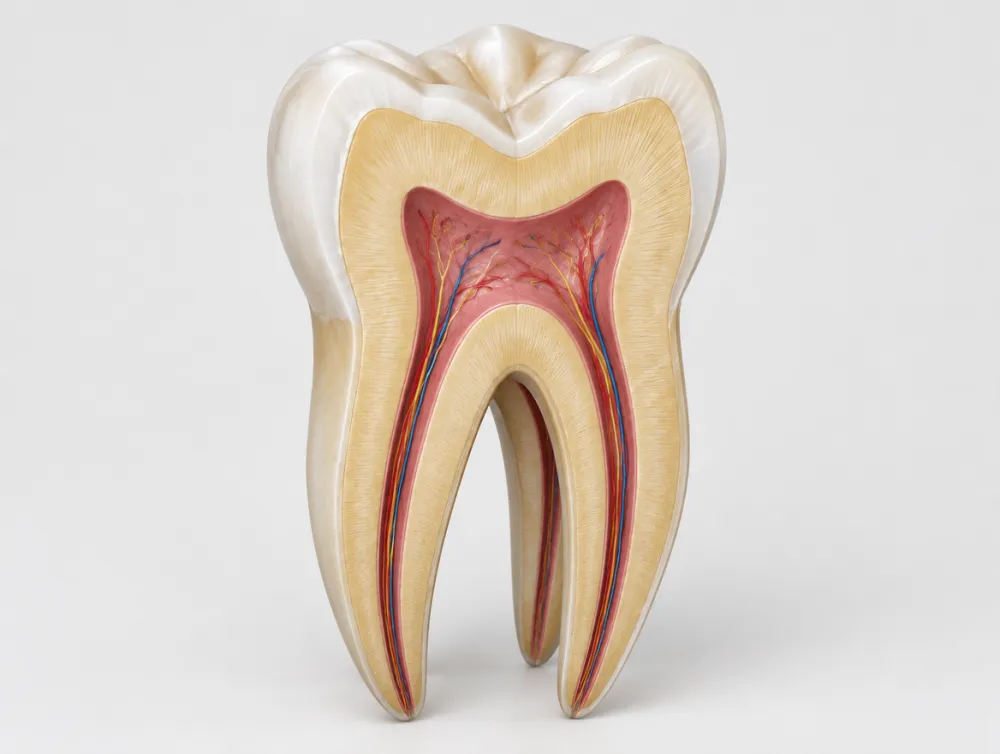
For a crown, the dentist removes a layer from every side of the tooth and from the top, so the crown can sit over it without looking bulky. Most of the enamel goes, and some dentine. In a lab study that weighed front teeth before and after preparation, full crown preparations removed about 63% to 72% of the tooth above the gum. Veneer preparations removed about 3% to 30%. A BBC report in 2022 and a UK dentist interviewed by the BBC in 2024 both put crown preparation at around 60% to 70% of the natural tooth.
None of that grows back. A crowned tooth will need a crown, or something like it, for the rest of its life.
What can go wrong afterwards
Even a well-made crown on a well-prepared tooth has risks. They are worth knowing before you decide how many teeth to treat.
- The nerve can die. Cutting a living tooth produces heat and exposes thousands of dentine tubes. In a Hong Kong study that followed living teeth under metal-ceramic crowns for about 14 years on average, around 16% lost their nerve. In a Scottish X-ray study, 19% of crowned teeth that had been alive when crowned showed signs of disease at the root tip. A tooth whose nerve dies needs root canal treatment or extraction.
- Sensitivity. Prepared teeth can be sensitive to cold for a while, and sometimes for longer.
- Decay at the edge. The tooth can still decay where the crown meets it. See decay under a crown.
- Gum problems. Crown edges placed deep under the gum, or bulky crowns that are hard to clean, can keep gums inflamed. See crown margins explained.
- The replacement cycle. Crowns don't last forever. Each replacement takes a little more tooth. Start at 22 and you may need several sets in a lifetime. See crowns in your 20s and 30s.
What the BBC and UK dentists reported
In July 2022 the BBC reported on the trend in a documentary and news article. For that report, the British Dental Association surveyed 1,000 UK dentists; 597 said they had treated patients with crown complications and had seen patients who went to Turkey for treatment. Nearly one in five said repair costs exceeded £5,000, and 346 said some remedial treatment had been done on the NHS. The BBC told the story of a woman who believed she was having veneers and later found she had 26 crowns, followed by nerve pain, an abscess and root canal treatment.
In 2024 the BBC reported an East Yorkshire dentist seeing more people with painful and broken crowns. She said young people with healthy teeth were going abroad for crowns because they wanted a particular look, and that fixing work done elsewhere is difficult when you don't know what was done underneath.
Those problems are real. They are also not unique to one country: crowning healthy teeth for colour is the issue, wherever it is done.
Signs of over-prepared teeth
If you are looking at photos online or at your own treatment, these are warning signs:
- Healthy front teeth filed into thin, pointed pegs.
- Every tooth in the smile crowned when only a few had fillings or damage.
- Crowns that look thick and bulky, or sit forward of the lips.
- Very bright, opaque shades that look the same on every tooth.
- Gums that are red, puffy or bleed around the new crowns weeks after fitting.
- Throbbing pain, swelling or a gum boil near a crowned tooth, which needs a dentist promptly.
How to avoid it
- Get a written plan firstTooth by tooth: crown, veneer, bonding, whitening or nothing, and why. The NHS checklist for treatment abroad also suggests checking the team's qualifications and making sure complications and aftercare are discussed.
- Ask why each tooth needs a crown"Big filling", "root filled", "cracked" are reasons. "To make them all match" is not, on its own.
- Ask about alternativesWhitening, bonding, aligners or veneers keep far more tooth. See crowns vs veneers.
- Know the words on the quote"Full veneer" means crown. See reading a crown plan.
- Don't decide on the chairA good clinic gives you time. The NHS warns against a hard sell and pressure to decide quickly.
- Plan your aftercareKeep your records and see a dentist for check-ups. See aftercare and longevity.
Where Precious Dental stands
We prefer to protect a healthy tooth rather than crown it. Every plan we send names each tooth and the treatment it needs. Teeth that only need whitening, bonding or a veneer are planned that way, even if it means a smaller job for us. Decay and gum problems are treated before anything is crowned, and you see your crowns at a try-in before they are fixed. Our dentists are licensed in Türkiye, and the clinic is licensed by the Ministry of Health.
If you already have crowns from elsewhere that are causing problems, see a dentist first; you can also send us photos and your X-ray and we will tell you honestly what we see.
Common questions
Is it true crowns file your teeth down to stumps?
A crown needs the tooth reduced all the way round, so a prepared tooth does look like a smaller version of itself. How small depends on the material, the tooth and the dentist. Teeth filed to thin, sharp points are a sign of over-preparation.
Can you reverse crowns?
No. Once a tooth has been prepared for a crown, it will need a crown or similar cover for the rest of its life. That is why the decision should be made tooth by tooth.
Is it safe to have crowns in Turkey?
Crowns are safe when they are done on the right teeth by a careful, licensed dentist, in Turkey or anywhere else. The risks reported in the UK press come mostly from crowning healthy teeth, rushed treatment and poor planning. Check the clinic's licence, ask for a written plan, and ask why each tooth needs what it is getting.
My Turkey teeth hurt. What should I do?
Pain, swelling, a bad taste, a gum boil or a tooth that throbs at night can mean the nerve of a tooth is inflamed or infected. See a dentist promptly, wherever you are; in the UK, NHS 111 can direct you to urgent dental care. Then contact the clinic that did the work.
Does Precious Dental crown healthy teeth?
We prefer to protect a healthy tooth rather than crown it. If your teeth are sound and you want a colour or shape change, your plan will normally suggest whitening, bonding or veneers instead.
Sources
- Edelhoff D, Sorensen JA (2002). Tooth structure removal associated with various preparation designs for anterior teeth. J Prosthet Dent
- Cheung GS, Lai SC, Ng RP (2005). Fate of vital pulps beneath a metal-ceramic crown or a bridge retainer. Int Endod J
- Saunders WP, Saunders EM (1998). Prevalence of periradicular periodontitis associated with crowned teeth in an adult Scottish subpopulation. Br Dent J
- BBC News (14 July 2022). Turkey teeth: Are cut-price reality TV teeth worth it?
- BBC News (2024). Dentist facing rising tide of broken 'Turkey teeth'
- NHS. Treatment abroad checklist
- NHS. Root canal treatment
- Oral Health Foundation. Dental tourism
Checked October 2026. Where we give our own view as a clinic, we say so.
Send a selfie smile. Get a written crown plan.
A few photos of your teeth or a recent X-ray is enough to start. A dentist looks at them and you get a written plan: which teeth, which material, why, and the price in pounds. If you don't need crowns, we'll tell you.